
Good, Better, Best: How to Choose the Right Fence for Your Vancouver Island Home
In our last post we compared ProLine composite and cedar head-to-head, and one idea stuck with a lot of readers: the cheapest fence to buy is rarely the cheapest fence to own. A cedar fence isn't really a one-time purchase — it's a maintenance program. By the time you've stained it half a dozen times and replaced a few warped boards, you've often spent more than you would have on a maintenance-free fence that's still standing strong.
So let's go deeper. Most fencing decisions come down to a simple framework we use with clients every week: Good, Better, Best. Here's how the three tiers stack up on Vancouver Island — and a few things most homeowners don't think about until it's too late.
First, the Mindset Shift: Cost Per Year, Not Cost Per Foot
Almost everyone shops for a fence by the upfront price per linear foot. It's the number on the quote, so it feels like the number that matters. But a fence is a 15-to-30-year purchase, and the real question is: what does it cost you per year of service?
A cheaper fence that needs staining every few years and a full rebuild at year 15 can quietly cost more per year than a premium fence you install once and forget. Once you start thinking in cost-per-year, the "expensive" option often turns out to be the bargain. Keep that lens as we walk through the tiers.
GOOD — Cedar & Wood Fencing
Cedar is the classic, budget-friendly choice — and for the right situation, it's still a great one. Western Red Cedar is naturally rot-resistant, widely available, and has that warm, traditional look BC homeowners love. It wins on upfront price, typically $60–$90 per linear foot installed.
The catch: cedar is wood, and wood needs care. Out here on the coast, that means staining or sealing every 2–3 years to fight off our heavy rain, salt air, and damp winters. Skip the maintenance and cedar greys, warps, splits, and grows mould along the grain — we see it on nearly every neglected cedar fence over five years old.
- Upfront cost: Lowest ($60–$90/ft installed)
- Lifespan: 15–20 years with diligent maintenance
- Maintenance: Stain/seal every 2–3 years; expect board replacements
- Warranty: None — it's a natural material, so the risk is all yours
- Best for: Tight upfront budgets, rental or short-term properties, sheltered yards, and homeowners who genuinely enjoy the upkeep and the rustic weathered look
BETTER — Vinyl Fencing
Vinyl is the sensible middle. It costs a little more upfront than cedar, but it eliminates almost all the maintenance. No staining, no sealing, no painting — an occasional rinse with the hose is all it asks. Vinyl won't rot, won't feed insects, and is UV-stabilized so it resists fading and yellowing.
Crucially, vinyl comes with a 20–25 year manufacturer warranty, so you're no longer carrying all the risk yourself. For families, pet owners, and anyone who wants privacy without weekend chores, vinyl is the "set it and mostly forget it" answer.
- Upfront cost: Mid-range ($70–$100/ft installed)
- Lifespan: 20–25 years
- Maintenance: Rinse occasionally — that's it
- Warranty: 20–25 year manufacturer warranty
- Available in: White, Light Grey, Tan, and Khaki; privacy, semi-privacy, picket, and rail styles
- Best for: Homeowners who want maximum privacy and minimal upkeep at a sensible price
BEST — ProLine Composite Fencing
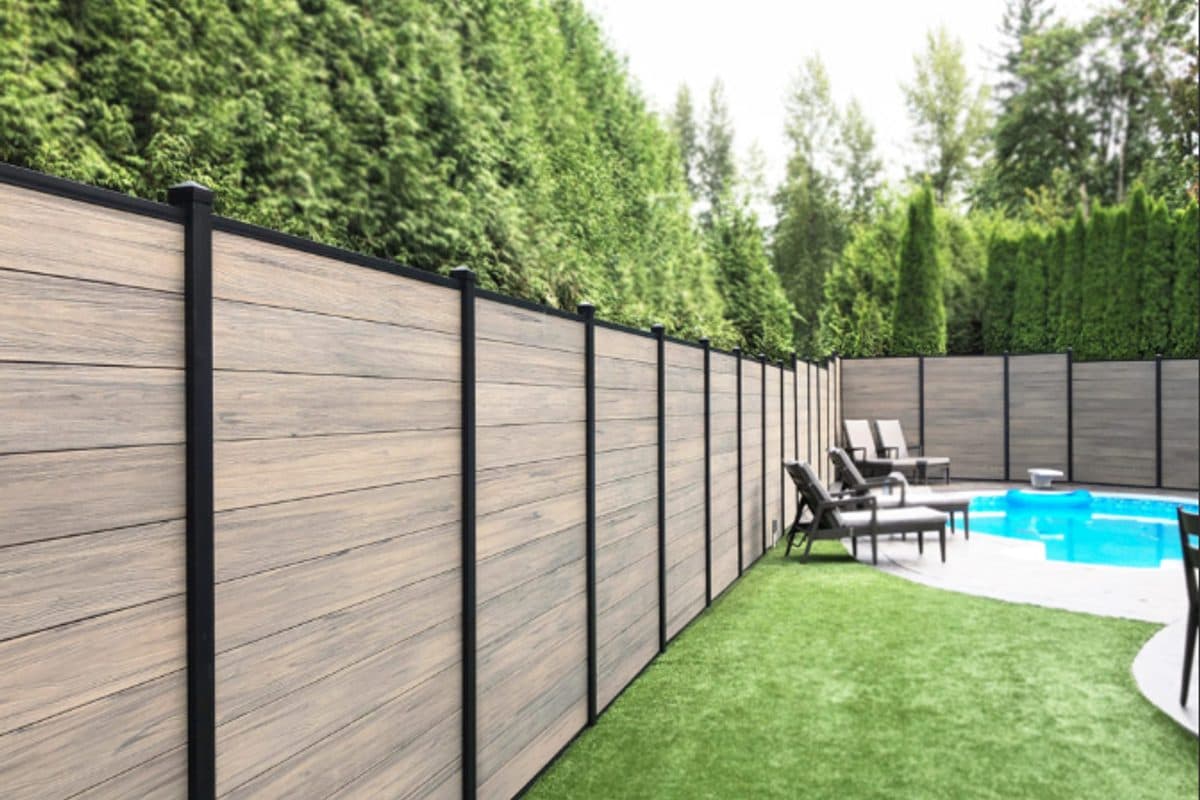
ProLine is the premium pick — and the one we recommend most often for forever homes on the Island. It's a co-extruded composite, patented in Canada, with a 360-degree waterproof shell wrapping every surface and edge. You get the natural wood-grain look (every board's texture is unique) with none of wood's weaknesses: no rot, no fading, no staining, ever.
What truly sets it apart is the 25-year limited manufacturer replacement warranty — a genuine replacement warranty, not a prorated one. In fencing, that's virtually unheard of. It's the closest thing to "buy it once and never think about it again."
- Upfront cost: Highest ($100–$130/ft installed)
- Lifespan: 25–30+ years
- Maintenance: None — rinse if you feel like it
- Warranty: 25-year limited replacement warranty
- Available in: Cedar Brown, Antique, and Black
- Best for: Forever homes, exposed coastal lots, and anyone who values their weekends and wants the lowest cost per year with the look of real wood
A Premium Alternative: Metal Fencing
Not every property needs a solid privacy fence. If your priorities are security, sightlines, or pool-code compliance, our premium metal fencing is a specialty option worth considering. Metal fencing won't rust, rot, or warp, carries a durable powder-coated finish that resists fading, and is lightweight yet strong. Think front yards, pool surrounds, and properties where you want to define a boundary without blocking the view.
The Numbers That Matter: True Cost Over 20 Years
Here's where the "cost per year" idea comes to life. The figures below are estimates for a typical residential privacy fence on Vancouver Island — your project will vary — but they show the pattern clearly.
| Tier | Upfront (installed) | 20-Year Upkeep & Replacement | ~20-Year Total | Effective Cost / Year |
|---|---|---|---|---|
| GOOD — Cedar | ~$75/ft | Stain every 2–3 yrs + board repairs, plus a likely rebuild around year 15–18 (~$90/ft) | ~$165/ft | ~$8.25/ft/yr |
| BETTER — Vinyl | ~$85/ft | Minimal (~$5/ft hardware over 20 yrs) | ~$90/ft | ~$4.50/ft/yr |
| BEST — ProLine | ~$115/ft | $0 — maintenance-free, still under warranty | ~$115/ft | ~$5.75/ft/yr |
Read that again: the option with the lowest upfront price ends up the most expensive to own — and costs nearly double per year of the low-maintenance options. Vinyl and ProLine both cost significantly less per year than cedar, and beyond the 20-year mark ProLine pulls ahead because it keeps going while a cedar fence has already been rebuilt.
The Things Most Homeowners Don't Factor In
1. A Warranty Is Risk Transfer
With cedar, you are the warranty. If a board warps or the fence fails early, that's your problem and your wallet. Step up to vinyl and a chunk of that risk shifts to the manufacturer for 20–25 years. With ProLine's replacement warranty, the manufacturer carries the risk for a quarter century. You're not just buying a fence — you're buying peace of mind.
2. The "Time Tax" Is Real Money
Staining a 100-foot cedar fence is a full weekend of prep, taping, brushing, and cleanup — every 2–3 years, for two decades. Even if you don't hire it out, your time has value. That's roughly 7–8 lost weekends over the life of the fence. Maintenance-free options hand those weekends back to you.
3. Curb Appeal Affects Resale
A crisp, uniform fence quietly boosts curb appeal and resale value. A greyed, leaning, patchy cedar fence does the opposite — buyers see a chore they'll inherit. If there's any chance you'll sell, the fence a buyer sees on day one matters more than the one you installed years ago.
4. The Honest-Fit Principle (This Isn't an Upsell)
Good/Better/Best isn't about pushing you to the priciest option — it's about matching the fence to your situation. Flipping a rental? Cedar may be exactly right. Building your forever home on an exposed coastal lot? ProLine will almost certainly cost you less in the long run. We'd rather tell you the truth and earn a customer for life than oversell you once.
5. The Environmental Angle
Re-buying a cedar fence every 15–18 years means more harvested timber and more waste over your lifetime. ProLine is made from recycled materials and lasts far longer, so fewer fences end up in the landfill. The greener choice and the longer-lasting choice happen to be the same one.
Which Tier Is Right for You?
A quick gut-check based on what we hear from clients every day:
- Choose GOOD (Cedar) if you're on a tight upfront budget, the property is a rental or short-term, the fence is in a sheltered spot, and you don't mind the upkeep.
- Choose BETTER (Vinyl) if you want maximum privacy with almost zero maintenance at a sensible price, and you like the idea of a long manufacturer warranty.
- Choose BEST (ProLine) if this is your forever home, your lot is exposed to coastal weather, you want the look of real wood without the work, and you want the lowest cost per year backed by a 25-year warranty.
- Consider Metal Fencing if security, open sightlines, or pool-code compliance matter more than full privacy.
Get an Honest Recommendation
Still on the fence? (We had to.) Use our free estimate builder to compare pricing across these options for your exact project, or contact us for a site visit. We'll walk your property, factor in your exposure and how long you plan to stay, and give you a straight answer about which tier makes the most sense — no pressure, no upsell.
Ready to Get Started?
Use our free estimate builder to see pricing for your project, or contact us for a site visit.